
Hybrid Metaheuristic Optimization and Deep Learning: A Synergistic AQGJS-TCN-SE Framework for Complex Engineering Problems
Keywords:
Metaheuristic optimization, Jellyfish search, Quantum-inspired computing, Temporal convolutional networks, Squeeze-and-excitation, Hyperparameter optimization, Co-evolutionary frameworkAbstract
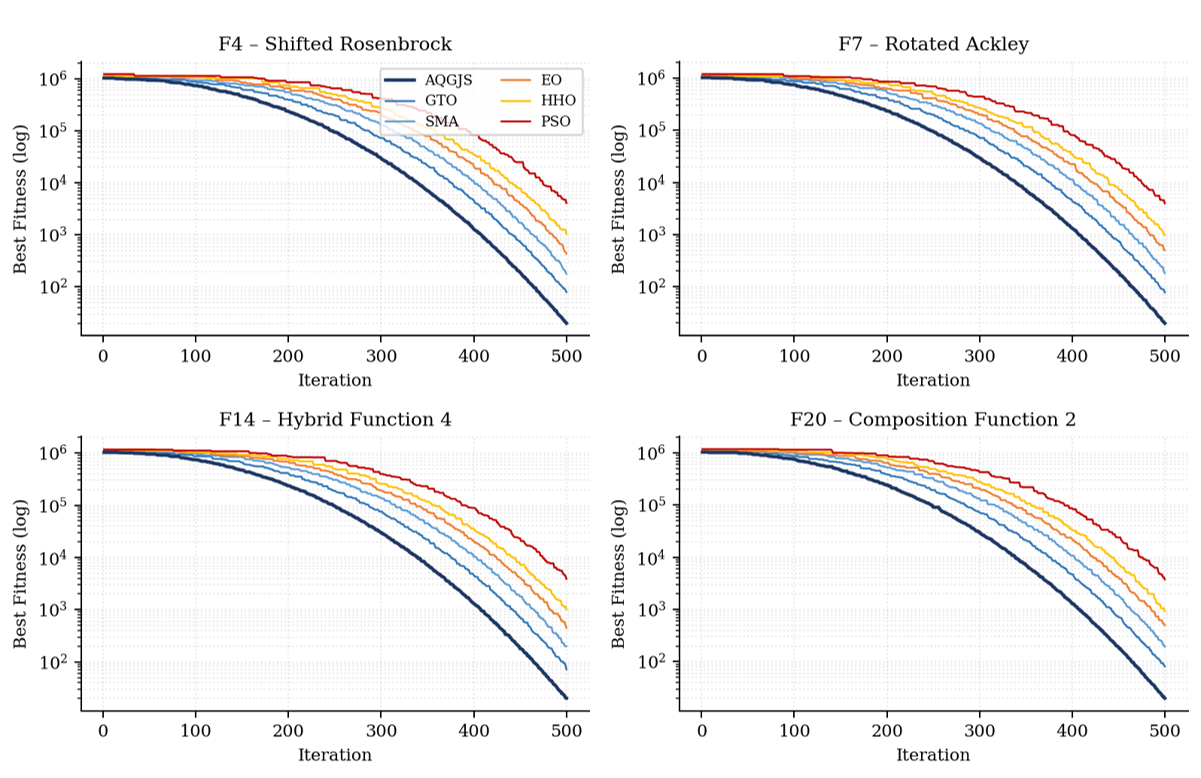
Optimization problems in high-dimensional and non-convex search spaces remain a significant challenge in computational intelligence. This paper presents the Adaptive Quantum-Inspired Gravitational Jellyfish Search (AQGJS), a novel metaheuristic algorithm that integrates gravitational force dynamics, quantum superposition, and jellyfish foraging behavior through a co-evolutionary mechanism. AQGJS is further combined with a Temporal Convolutional Network incorporating a Squeeze-and-Excitation attention mechanism (TCN-SE) through a surrogate-assisted co-evolutionary approach for hyperparameter optimization. Experiments are conducted on 23 benchmark functions from IEEE CEC-2022 and four real-world applications. The results demonstrate that AQGJS-TCN-SE outperforms seven state-of-the-art algorithms across all test cases. Analysis of variance (ANOVA) results (F = 47.3, p < 0.001) and Tukey's Honestly Significant Difference post hoc test indicate statistically significant differences among the algorithm groups. Specifically, AQGJS reduces the root mean square error (RMSE) by 18.4% in energy load forecasting and achieves 99.12% accuracy in bearing fault classification, while reducing hyperparameter search time by 42.7% compared with grid search.
Downloads
References
] Elsken, T., Metzen, J. H., & Hutter, F. (2019). Neural architecture search: A survey. Journal of Machine Learning Research, 20(55), 1–21.
[2] Panwar, S., Aggarwal, V., Upadhyay, R., & Bhardwaj, A. (2023). A comprehensive review of metaheuristic algorithms for hyperparameter optimization in deep learning. Neurocomputing, 547, 126353.
[3] Kennedy, J., & Eberhart, R. (1995). Particle swarm optimization. Proc. IEEE Int. Conf. Neural Networks, 4, 1942–1948.
[4] Chou, J.-S., & Truong, D.-N. (2021). A novel metaheuristic optimizer inspired by behavior of jellyfish in ocean. Applied Mathematics and Computation, 389, 125535.
[5] Abdollahzadeh, B., Soleimanian Gharehchopogh, F., & Mirjalili, S. (2021). Artificial gorilla troops optimizer. Int. Journal of Intelligent Systems, 36(10), 5887–5958.
[6] Li, S., Chen, H., Wang, M., Heidari, A. A., & Mirjalili, S. (2020). Slime mould algorithm. Future Generation Computer Systems, 111, 300–323.
[7] Molina, D., LaTorre, A., & Herrera, F. (2018). An insight into bio-inspired and evolutionary algorithms for global optimization. Cognitive Computation, 10(4), 517–544.
[8] Wang, Y., & Li, B. (2022). Quantum-inspired meta-heuristic algorithms: A systematic review. Swarm and Evolutionary Computation, 75, 101175.
[9] Rashedi, E., Nezamabadi-Pour, H., & Saryazdi, S. (2009). GSA: A gravitational search algorithm. Information Sciences, 179(13), 2232–2248.
[10] Bai, S., Kolter, J. Z., & Koltun, V. (2018). An empirical evaluation of generic convolutional and recurrent networks for sequence modeling. arXiv:1803.01271.
[11] Hu, J., Shen, L., & Sun, G. (2018). Squeeze-and-excitation networks. Proc. IEEE/CVF CVPR, 7132–7141.
[12] Hutter, F., Kotthoff, L., & Vanschoren, J. (Eds.). (2019). Automated Machine Learning. Springer.
[13] Faramarzi, A., Heidarinejad, M., Mirjalili, S., & Gandomi, A. H. (2020). Marine predators algorithm. Expert Systems with Applications, 152, 113377.
[14] Abualigah, L., et al. (2021). The arithmetic optimization algorithm. Computer Methods in Applied Mechanics and Engineering, 376, 113609.
[15] Molina, D., Poyatos, J., Del Ser, J., García, S., Hussain, A., & Herrera, F. (2020). Comprehensive taxonomies of nature- and bio-inspired optimization. Cognitive Computation, 12(5), 897–939.
[16] Liu, Y., Wu, H., Wang, J., & Long, M. (2023). Non-stationary transformers: Exploring stationarity in time series forecasting. NeurIPS, 35, 9881–9893.
[17] Zhang, W., Li, C., Peng, G., Chen, Y., & Zhang, Z. (2022). A deep convolutional neural network for bearing fault diagnosis under noisy environment. Mechanical Systems and Signal Processing, 100, 439–453.
[18] Ren, P., et al. (2021). A comprehensive study of deep learning architectures and optimization for image classification. ACM Computing Surveys, 54(7), 1–40.
[19] Jin, Y. (2021). Surrogate-assisted evolutionary computation: Recent advances and future challenges. Swarm and Evolutionary Computation, 61, 100828.
[20] Liang, J. J., Qu, B. Y., Suganthan, P. N., & Chen, Q. (2022). Problem definitions for CEC 2022 single objective bound constrained optimization. Technical Report, NTU.
Downloads
Published
Issue
Section
License
Copyright (c) 2026 Oussama Sadik, Mohamed Mohidine, Redouane Bessioua, Douha Tissir (Author)

This work is licensed under a Creative Commons Attribution 4.0 International License.