
SoilClass: A Novel Image Dataset For Soil Classification
Keywords:
soil types, soil classification, CNN, Deep LearningAbstract
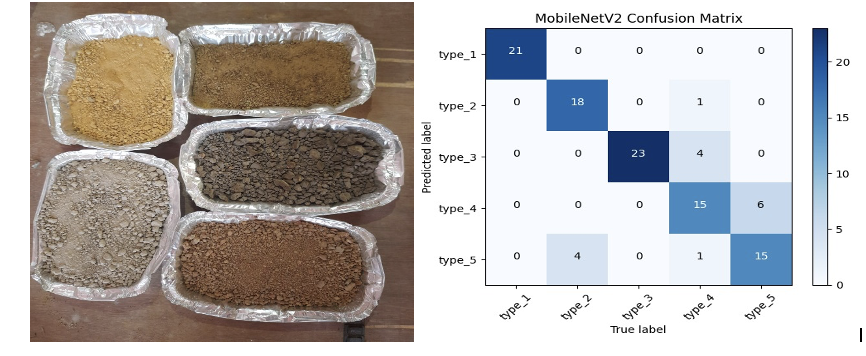
Soil classification is one of the most important topics in the field of agricultural development. It plays a vital role in agricultural, environmental science, and geotechnical engineering, and it helps in soil tillage, crop selection, moisture level estimation, and automation. Soil classification using conventional and laboratory methods is time-consuming, expensive, and requires a high level of skill. This study describes a quick and cost-effective method for predicting soil types using soil images. To create the soil image dataset, a total of five types of soil samples were collected from different parts of West Bengal. Later, the collected samples are tested with the help of the soil testing laboratory, West Midnapore, West Bengal, India. Later, we created an imaging setup and captured a total of 552 images of these five categories of soils from different angles and various light conditions. We used five CNN models, namely, MobileNetV2, InceptionV3, ResNet152, ResNet50, and DenseNet201 for the soil classification task. In our dataset, DenseNet201 and InceptionV3 achieved the highest accuracy, and ResNet50 achieved the lowest accuracy.
Downloads
References
[1] Ronaldo, A. D., Hamzah, H., & Diqi, M. (2021). Effective Soil type classification using convolutional neural network. International Journal of Informatics and Computation, 3(1), 20-29.
[2] Girme, S., Mutke, S., Kokare, S., Khobragade, A., & Tambe, K. (2021). Soil Classification Using Convolutional Neural Network and Crop Recommendation Based On Support Vector Machine. International Research Journal Of Modernization In Engineering Technology and Science, 3(06), 2021.
[3] Li, X., Fan, P., Li, Z., Chen, G., Qiu, H., & Hou, G. (2021). Soil classification based on deep learning algorithm and visible near-infrared spectroscopy. Journal of Spectroscopy, 2021, 1-11.
[4] Srivastava, P., Shukla, A., & Bansal, A. (2021). A comprehensive review on soil classification using deep learning and computer vision techniques. Multimedia Tools and Applications, 80, 14887-14914.
[5] Barkataki, N., Mazumdar, S., Singha, P. B. D., Kumari, J., Tiru, B., & Sarma, U. (2021, August). Classification of soil types from GPR B scans using deep learning techniques. In 2021 International Conference on Recent Trends on Electronics, Information, Communication & Technology (RTEICT) (pp. 840-844). IEEE.
[6] Barman, U., Choudhury, R. D., Sarma, S. K., Senapoty, R. K., Singh, A., Borah, A., & Kalita, G. (2022). Smartphone assisting convolutional neural networks for soil texture classification in dry and wet humid conditions in West Guwahati, Assam. Journal of Applied and Natural Science, 14(4), 1351-1359.
[7] Kim, D., Kim, T., Jeon, J., & Son, Y. (2023). Convolutional Neural Network-Based Soil Water Content and Density Prediction Model for Agricultural Land Using Soil Surface Images. Applied Sciences, 13(5), 2936.
[8] Azadnia, R., Jahanbakhshi, A., Rashidi, S., & Bazyar, P. (2022). Developing an automated monitoring system for fast and accurate prediction of soil texture using an image-based deep learning network and machine vision system. Measurement, 190, 110669.
[9] Zhao, Z., Feng, W., Xiao, J., Liu, X., Pan, S., & Liang, Z. (2022). Rapid and Accurate Prediction of Soil Texture Using an Image-Based Deep Learning Autoencoder Convolutional Neural Network Random Forest (DLAC-CNN-RF) Algorithm. Agronomy, 12(12), 3063.
[10] Uddin, M., & Hassan, M. R. (2022). A novel feature based algorithm for soil type classification. Complex & Intelligent Systems, 8(4), 3377-3393.
[11] Vibhute, A. D., & Kale, K. V. (2023). Mapping several soil types using hyperspectral datasets and advanced machine learning methods. Results in Optics, 12, 100503.
[12] Chu, Y., Luo, Y., Chen, F., Zhao, C., Gong, T., Wang, Y., ... & Hong, M. (2023). Visualization and accuracy improvement of soil classification using laser-induced breakdown spectroscopy with deep learning. Iscience, 26(3).
[13] Pandiri, D. K., Murugan, R., & Goel, T. (2024). Smart soil image classification system using lightweight convolutional neural network. Expert Systems with Applications, 238, 122185.
[14] Rahman, F., Khan, M. A. R., & Alam, M. (2025). Hybrid PSO-GA Optimization for enhancing decision tree performance in soil classification and crop cultivation prediction. Evolutionary Intelligence, 18(1), 30.
[15] Zhang, Y., Li, R. F., Huang, L., & Liu, F. T. (2026). Enhancing Soil Classification With DropKey‐Augmented Lightweight Transformers. Concurrency and Computation: Practice and Experience, 38(7), e70662.
[16] Shorten, C., & Khoshgoftaar, T. M. (2019). A survey on image data augmentation for deep learning. Journal of big data, 6(1), 1-48.
[17] Sandler, M., Howard, A., Zhu, M., Zhmoginov, A., & Chen, L. C. (2018). Mobilenetv2: Inverted residuals and linear bottlenecks. In Proceedings of the IEEE conference on computer vision and pattern recognition (pp. 4510-4520).
[18] He, K., Zhang, X., Ren, S., & Sun, J. (2016). Deep residual learning for image recognition. In Proceedings of the IEEE conference on computer vision and pattern recognition (pp. 770-778).
[19] Szegedy, C., Vanhoucke, V., Ioffe, S., Shlens, J., & Wojna, Z. (2016). Rethinking the inception architecture for computer vision. In Proceedings of the IEEE conference on computer vision and pattern recognition (pp. 2818-2826).
[20] Huang, G., Liu, Z., Van Der Maaten, L., & Weinberger, K. Q. (2017). Densely connected convolutional networks. In Proceedings of the IEEE conference on computer vision and pattern recognition (pp. 4700-4708).
[21] Ghosal, D., Das, A., & Dhal, K. G. (2022). A comparative study among clustering techniques for leaf segmentation in rosette plants. Pattern Recognition and Image Analysis, 32(1), 129-141.
[22] Dhal, K. G., Ray, S., Barik, S., & Das, A. (2023). Illumination-free clustering using improved slime mould algorithm for acute lymphoblastic leukemia image segmentation. Journal of Bionic Engineering, 20(6), 2916-2934.
Downloads
Published
Issue
Section
License
Copyright (c) 2026 Bishal Chakraborty, Soumik Pan, Arunita Das, Krishna Gopal Dhal (Author)

This work is licensed under a Creative Commons Attribution 4.0 International License.